Author: appsdev@imanila.ph

Meet BASE’s new General Manager!

“Our vision is really to work towards scaling up: beneficiaries, partnerships, and expansion of research and knowledge base on these sustainable materials.”
– Dr. Pablo Jorillo

This April 2020, Base Bahay saw some internal changes and welcomed Pablo Jorillo as its new General Manager. Doc PJ, as his colleagues call him, spent 15 years as general manager of HILTI Philippines before moving to Base. Seeing an opportunity open in Base Bahay, Doc PJ decided that it was time to try his hand working in the development sector.

At the same time, his predecessor Maricen Jalandoni has moved up to a new role as Hilti Foundation Liaison to Asia, developing projects and partnerships for the Hilti Foundation in the region while she continues to serve as President of Base Bahay Foundation and Chairman of the Board of Trustees.

Four months into his transition from Corporate to Development, Doc PJ cites the Covid-19 quarantine’s limitations as the first obstacle he has to hurdle. Despite this, work at Base continues to push forward at a faster pace following the move; when asked about the vision he has for Base moving forward, Doc PJ readily discusses the growth not just of the Foundation, but of the bamboo construction industry as a whole.

“It’s an exciting time for bamboo construction. Our vision is really to work towards scaling up: beneficiaries, partnerships, and even expansion of research and knowledge. We are looking to scale up not just in the number of houses or the number of beneficiaries, but of expanding social impact, environmental impact, and, of course, research, innovation and technology application of bamboo as a structural material.”

Base aims to achieve two main things: First, to be known as the leader in bamboo construction technology and second, to be a champion of sustainable construction. These objectives can be achieved by creating and enabling a greater network of partners, not just in the social development sector but also in the professional construction and the academe. Ultimately, working with all three would greatly help promote the widespread use of structural bamboo.

Additionally, scaling up is not limited only to the Philippines; Base together with Hilti Foundation envision bringing the technology to other countries and partnering and collaborating with experts from around the world on further research and innovations. Currently, Base has an ongoing project with Habitat for Humanity Nepal in Jhapa and is partnering with research institutions from the UK, Malaysia, Austria and Liechtenstein. Further on, Base aims to pursue more research with research partners from Japan and Switzerland, among others, and bring the technology to fellow developing countries like Cambodia, Indonesia, and India.

As with every project, success can only be achieved through everyone coming together as a team. “We will rally everyone to achieve this noble vision,” Doc PJ points out, “Engineers, Marketing, Admin, Supply chain, and everyone will work as one towards this vision.”

1st FB Live: Philippine National Standards on Bamboo Structures

Following the adaptation of new International Standards on Bamboo Structures by the Bureau of Philippine Standards, Base Bahay Foundation held its first Facebook Live last 09 July 2020 on what these Standards are and what this means for bamboo research and construction in the Philippines.

The discussion tackled the new Philippine National Standard (PNS) 19624, which specifies grading principles and procedures for bamboo culms, and PNS 22157, which specifies testing methods for mechanical properties of bamboo culms. Experts representing different fields of bamboo engineering lent their knowledge as speakers in the event.

As a part of the task force that developed the International Standards on bamboo structures, Prof. David Trujillo of Coventry University first discussed the importance of Standards, as well as its origins. Originally International Standards developed through extensive research by a working group of a team of engineers from across the world on bamboo structures. These Standards were gradually adopted by various countries and adapted to each area’s needs.

In a presentation by Professor Lessandro Garciano of the De La Salle University, he discussed where the Philippines is in bamboo research, and how the new PNS 22157 affects bamboo research. PNS 22157 specifies testing methods for the determination of the physical and mechanical properties of bamboo culms. These include compression strength and stiffness parallel to fibers, tension strength and stiffness parallel to fibers, bending strength and stiffness parallel to fibers, strength parallel to fibers, and tension strength perpendicular to fibers. Even before adopting these as Philippine National Standards, studies done by the De La Salle University and Base Bahay had already been following the ISO 22157.

Among the studies being carried out are the determination of shear strength of Bambusa blumeana, locally known as Kawayan Tinik; and the determination of mechanical properties of various bamboo species, including that of the local specie Dendrocalamus asper. Also, three types of bamboo connections were tested, which can be used in the Cement-Bamboo Frame technology.

Further research is underway, which will assist the development of a local structural code for bamboo, now guided by the PNS 22157 and the proposed ISO 22156.

Finally, to represent the supplier side is Architect Ray Villanueva, co-founder of Kawayan Collective, a social enterprise that promotes bamboo and bamboo products. The Kawayan Collective treatment facility has been using a bamboo grading system. However, now that the Philippines has adopted PNS 19624, which specifies bamboo grading procedures, suppliers such as Kawayan Collective can now use a more complete and standardized grading system. Currently, Kawayan Collective implements stringent quality standards that include visual and machine grading and quarterly orientations and meetings with local bamboo harvesters on bamboo specifications, areas for improvement and coordination, and sustainable practices. Visual grading done by Kawayan Collective determines condition properties (mold and insect infestation, fissures, and longitudinal indentations), geometric properties (wall thickness, diameter, length, and bow), and skin or fiber damage. Following the new PNS 19624, part of the improvements Kawayan Collective will be implementing is to provide customers with a Cut Sheet that details the specifications and mechanical properties of the bamboo they buy.

Base Bahay’s General Manager, Pablo Jorillo, moderated the event. This activity marks the first in a series of FB Live discussions on bamboo structures, innovation, and research.

The recorded video may be accessed on our Facebook page using this link.

BASE and Coventry University sign MOU on joint Bamboo Research

Base Bahay Foundation and the Coventry University in the UK has entered into an understanding for collaborative works in bamboo research. This Understanding aims to support more research and fellowship opportunities on alternative building technology for the staff, students, and associates of both parties.

The Understanding, which was signed May 12, aims to discuss the potential of the following possible projects:

  1. Research fellowship opportunities provided by Base Bahay to Coventry staff and students;
  2. Collaborative Online International Learning projects for both BBFI and Coventry students, undergraduate and post-graduate; and
  3. Collaborative research project supervision and short study visits for students of BBFI at Coventry University.

Once finalized, this Understanding may potentially provide both Filipino and UK staff and students with more opportunities for their research, with the ultimate aim of drastically furthering developments in alternative building technologies.

Now more than ever, we are seeing the importance and urgency of promoting alternative sustainable technologies in construction. Join us as we work towards making this happen!

Stay tuned to both our social media sites and this website for more updates.

BISCAST invites BASE to share about CBF in preparation for the DRIA Competition

BISCAST (Bicol State College of Applied Sciences and Technology) invited BASE to share its work and its technology CBF before its faculty and students and of KMUTT (King Mongkut’s University of Technology Thonburi) on January 24, 2020.

BISCAST organized the activity to prepare its students and of KMUTT for the DRIA (Disaster Resilience in Asia) competition in July in Thailand. DRIA is an annual design competition that encourages foresighted urban and architectural design proposals, as well as promotes innovation in building technologies to ensure a specific community’s resiliency, particularly before and during a disastrous event.

For 2020, the speculative proposals shall engage design, technology, and policies that connect the physical and the social aspects of Naga City to promote its resiliency. BASE has a history of building resilient houses in the disaster-prone region of Bicol.

You may recall that BASE constructed 3 model houses in Guinubatan Albay to test the technology’s resistance against typhoons in 2014. And in 2018, Base completed 50 housing units in Sorsogon City, which had been tested by Typhoon Tisoy in December 2020.

Base presents at AP HOUSING FORUM 2019 Breakaway: CBF As an Affordable Housing Solution

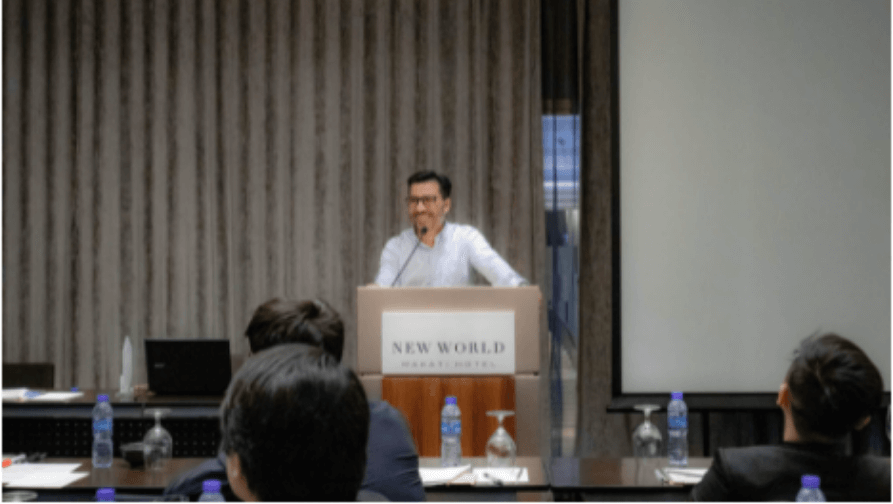
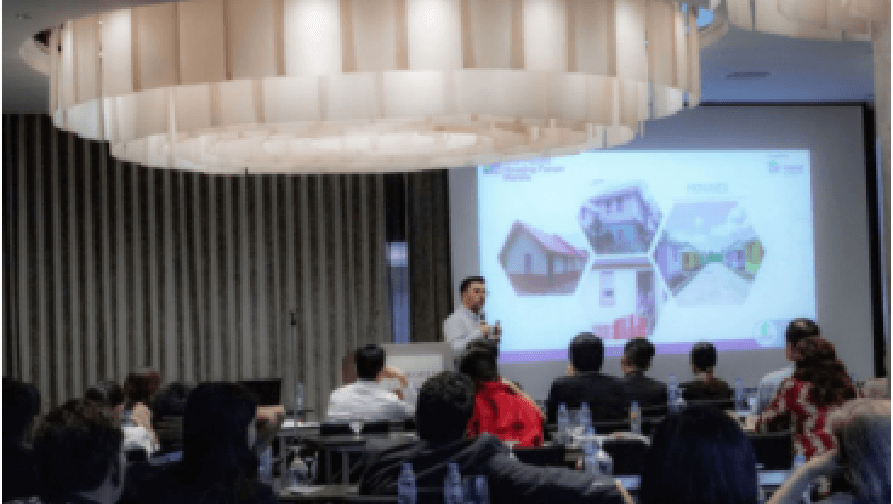
Last July Base Bahay Foundation, Inc. (BBFI) was invited to speak at this year’s Asia Pacific Housing Forum (APHF). The Housing Forum was a 3-day conference organized by Habitat for Humanity with the aim to connect stakeholders engaged in finding solutions for inadequate shelter issues and promoting affordable housing as a driver of economic growth. Both Base Bahay Foundation’s General Manager Maricen Jalandoni, and Head of Product Development Engineer Luis Lopez were invited to speak.

After Ms. Jalandoni presented as a plenary speaker for the AP Housing forum 2019, Mr. Lopez was also invited as speaker for the afternoon break out session to talk about the Cement Bamboo Frame technology as an affordable housing solution. During his talk, Luis highlighted the importance of seeing bamboo for its unique resiliency, a natural resource largely underappreciated and underestimated in the Philippines despite its structural renown in his hometown in Colombia and its Latin American neighbors, as well as other parts of Asia.

Luis began with a brief history of the Bahareque technology, a building method originating from Colombia whose evolution and development shone after the age-old structures withstood some of the biggest earthquakes that have destroyed entire cities of steel-cement frames. Luis himself was part of the research group that worked on the Bahareque building code that was published in 2002, after the local government saw the urgent need for structural resiliency in the face of Colombia’s constant earthquake threat.

Later, Luis talked about how Bahareque roots have led to the development of the Cement Bamboo Frame Technology (or CBF): a bamboo building technology using local Philippine bamboo, engineered for the trials of Philippine climate. After years of research and development, Luis and Base Bahay have since identified local bamboo species for structural-grade building, computed for loadbearing requirements, developed bamboo treatment methods against infestation, passed the minimum 1-hour fire rating, and typhoon wind tests simulated by placing actual housing designs in one of the most typhoon-hit areas of the Philippines: Guinubatan, Albay. This, along with having met all requirements of conventional housing under the National Structural Code of the Philippines, resulted in the Cement Bamboo Frame Technology’s accreditation under the Accreditation of Innovative Technologies or AITECH under the National Housing Authority. Base has since provided proof of concept through over 600 houses all around the Philippines.

While the building method has proven itself so far, Luis emphasized that the learning has not stopped. Constant research and development are on-going, with the hope of further developing the technology, as well as any other alternative technologies and building methods that utilize Bamboo. In the end, it isn’t about the material, but how it is used.

Base Bahay Foundation, Inc. at the AP Housing Forum 2019 in Makati, Philippines

Last July Base Bahay Foundation, Inc. (BBFI) was invited to speak at this year’s Asia Pacific Housing Forum (APHF). The Housing Forum was a 3-day conference organized by Habitat for Humanity with the aim to connect stakeholders engaged in finding solutions for inadequate shelter issues and promoting affordable housing as a driver of economic growth. This year, each day of the program was dedicated to one of three categories: “Land Ownership and the Key to Socialized Housing”, “Markets, Public and Private sector Solutions for Housing”, and “Building Disaster Resilient Communities and Cities.” Various groups were present, from local government and non-government organizations, to members of the private sector.

On the second day, under “Markets, Public, and Private sector Solutions for Housing,” General Manager of Base Bahay Foundation Maricen Jalandoni was invited as speaker for the morning plenary session where she talked about the Cement Bamboo Frame Technology and Building Beyond Today. Here, Ms. Jalandoni was able to emphasize the importance of building for tomorrow, a conversation relevant since the recent natural calamities have devastated Filipinos.
“Building beyond today is really thinking about the future. How do we build today so we don’t have to worry about events like what happened in Batanes, with houses that have fallen because of earthquakes; or how we’re going to help people who are constantly worried when the next typhoon comes”

Through the stories of those Base Bahay has worked with from harvesting to housing beneficiaries, Ms. Jalandoni urged that it was important not just for other NGOs and LGUs participate but the private sector as well; proposing that such a product could be delivered that includes the participation and consideration of those along the chain of production.

“It’s not enough that people are given houses, but what is important is along the entire chain, from the time you start to the time you turn over the houses, people have learned the skills that they can use for the future.”

Ms. Jalandoni ended by reiterating: Base hopes to show the importance of building with a material that is sustainable, but more importantly, building with a system that involves the community and that has a positive impact on society.