BISCAST invites BASE to share about CBF in preparation for the DRIA Competition

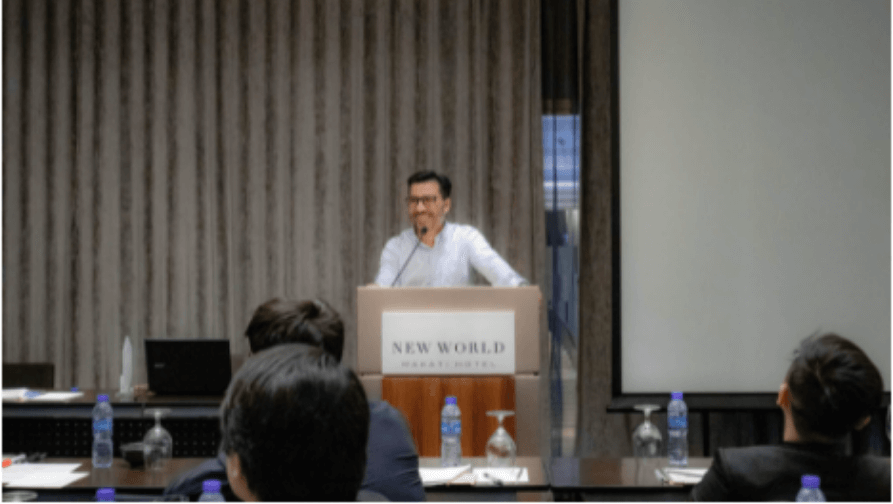
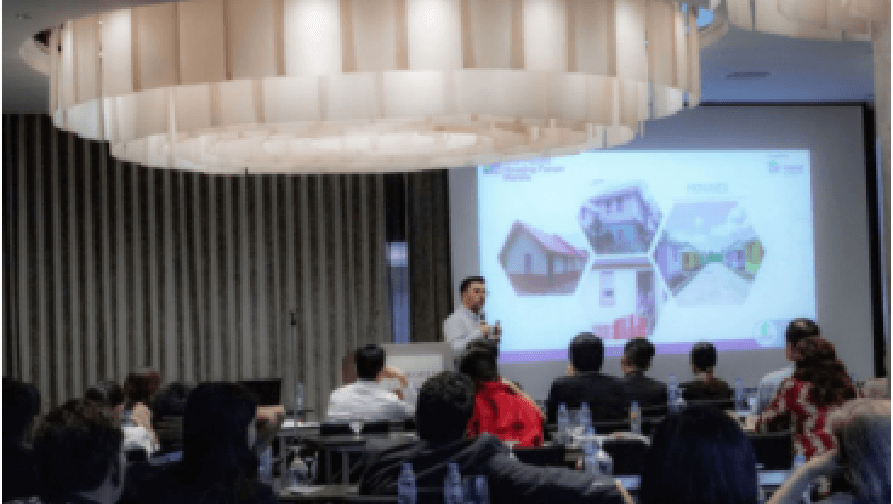
BISCAST (Bicol State College of Applied Sciences and Technology) invited BASE to share its work and its technology CBF before its faculty and students and of KMUTT (King Mongkut’s University of Technology Thonburi) on January 24, 2020.

BISCAST organized the activity to prepare its students and of KMUTT for the DRIA (Disaster Resilience in Asia) competition in July in Thailand. DRIA is an annual design competition that encourages foresighted urban and architectural design proposals, as well as promotes innovation in building technologies to ensure a specific community’s resiliency, particularly before and during a disastrous event.

For 2020, the speculative proposals shall engage design, technology, and policies that connect the physical and the social aspects of Naga City to promote its resiliency. BASE has a history of building resilient houses in the disaster-prone region of Bicol.

You may recall that BASE constructed 3 model houses in Guinubatan Albay to test the technology’s resistance against typhoons in 2014. And in 2018, Base completed 50 housing units in Sorsogon City, which had been tested by Typhoon Tisoy in December 2020.

Base presents at AP HOUSING FORUM 2019 Breakaway: CBF As an Affordable Housing Solution

Last July Base Bahay Foundation, Inc. (BBFI) was invited to speak at this year’s Asia Pacific Housing Forum (APHF). The Housing Forum was a 3-day conference organized by Habitat for Humanity with the aim to connect stakeholders engaged in finding solutions for inadequate shelter issues and promoting affordable housing as a driver of economic growth. Both Base Bahay Foundation’s General Manager Maricen Jalandoni, and Head of Product Development Engineer Luis Lopez were invited to speak.

After Ms. Jalandoni presented as a plenary speaker for the AP Housing forum 2019, Mr. Lopez was also invited as speaker for the afternoon break out session to talk about the Cement Bamboo Frame technology as an affordable housing solution. During his talk, Luis highlighted the importance of seeing bamboo for its unique resiliency, a natural resource largely underappreciated and underestimated in the Philippines despite its structural renown in his hometown in Colombia and its Latin American neighbors, as well as other parts of Asia.

Luis began with a brief history of the Bahareque technology, a building method originating from Colombia whose evolution and development shone after the age-old structures withstood some of the biggest earthquakes that have destroyed entire cities of steel-cement frames. Luis himself was part of the research group that worked on the Bahareque building code that was published in 2002, after the local government saw the urgent need for structural resiliency in the face of Colombia’s constant earthquake threat.

Later, Luis talked about how Bahareque roots have led to the development of the Cement Bamboo Frame Technology (or CBF): a bamboo building technology using local Philippine bamboo, engineered for the trials of Philippine climate. After years of research and development, Luis and Base Bahay have since identified local bamboo species for structural-grade building, computed for loadbearing requirements, developed bamboo treatment methods against infestation, passed the minimum 1-hour fire rating, and typhoon wind tests simulated by placing actual housing designs in one of the most typhoon-hit areas of the Philippines: Guinubatan, Albay. This, along with having met all requirements of conventional housing under the National Structural Code of the Philippines, resulted in the Cement Bamboo Frame Technology’s accreditation under the Accreditation of Innovative Technologies or AITECH under the National Housing Authority. Base has since provided proof of concept through over 600 houses all around the Philippines.

While the building method has proven itself so far, Luis emphasized that the learning has not stopped. Constant research and development are on-going, with the hope of further developing the technology, as well as any other alternative technologies and building methods that utilize Bamboo. In the end, it isn’t about the material, but how it is used.

Base Bahay Foundation, Inc. at the AP Housing Forum 2019 in Makati, Philippines

Last July Base Bahay Foundation, Inc. (BBFI) was invited to speak at this year’s Asia Pacific Housing Forum (APHF). The Housing Forum was a 3-day conference organized by Habitat for Humanity with the aim to connect stakeholders engaged in finding solutions for inadequate shelter issues and promoting affordable housing as a driver of economic growth. This year, each day of the program was dedicated to one of three categories: “Land Ownership and the Key to Socialized Housing”, “Markets, Public and Private sector Solutions for Housing”, and “Building Disaster Resilient Communities and Cities.” Various groups were present, from local government and non-government organizations, to members of the private sector.

On the second day, under “Markets, Public, and Private sector Solutions for Housing,” General Manager of Base Bahay Foundation Maricen Jalandoni was invited as speaker for the morning plenary session where she talked about the Cement Bamboo Frame Technology and Building Beyond Today. Here, Ms. Jalandoni was able to emphasize the importance of building for tomorrow, a conversation relevant since the recent natural calamities have devastated Filipinos.
“Building beyond today is really thinking about the future. How do we build today so we don’t have to worry about events like what happened in Batanes, with houses that have fallen because of earthquakes; or how we’re going to help people who are constantly worried when the next typhoon comes”

Through the stories of those Base Bahay has worked with from harvesting to housing beneficiaries, Ms. Jalandoni urged that it was important not just for other NGOs and LGUs participate but the private sector as well; proposing that such a product could be delivered that includes the participation and consideration of those along the chain of production.

“It’s not enough that people are given houses, but what is important is along the entire chain, from the time you start to the time you turn over the houses, people have learned the skills that they can use for the future.”

Ms. Jalandoni ended by reiterating: Base hopes to show the importance of building with a material that is sustainable, but more importantly, building with a system that involves the community and that has a positive impact on society.

Rejoicing through new partnerships

THE REJOICE VILLAGE

This July 2019, Base Bahay Foundation signed a new project with 4P ForPeople, Inc. for the construction and development of children’s village in Nasugbu, Batangas.

In line with its belief that giving children the opportunity to education is important and key to combating poverty, 4P has initiated and partnered with Base for the Rejoice Village: a small community that helps vulnerable children and families by facilitating security and development for its residents.

The Village is envisioned to have a children’s home that can house up to 48 orphaned children, 30 housing units for families from the slums of Manila, as well as a multi-purpose building for use by the children and community members. The project is also notably environmentally friendly with designs to reduce energy consumption, and emphasis on local labor and natural building materials- a perfect fit for Base Bahay’s building philosophy. 4P hopes to drive developments toward being self-sufficient in terms of creating its own energy, food and water, creating job opportunities and livelihood projects and the like, thus making what the organization calls a fullworthy society.

Construction is set to begin by August of 2019, with all structures to be built using Base Bahay’s Cement-Bamboo Frame Technology. This ensures that its residents have comfortable, disaster-resilient homes, in the hopes of empowering and better-equipping them for a better future.

Housing meets livelihood: San Roque Eco-Village Turnover and Skills Training Graduation

A Thursday to remember

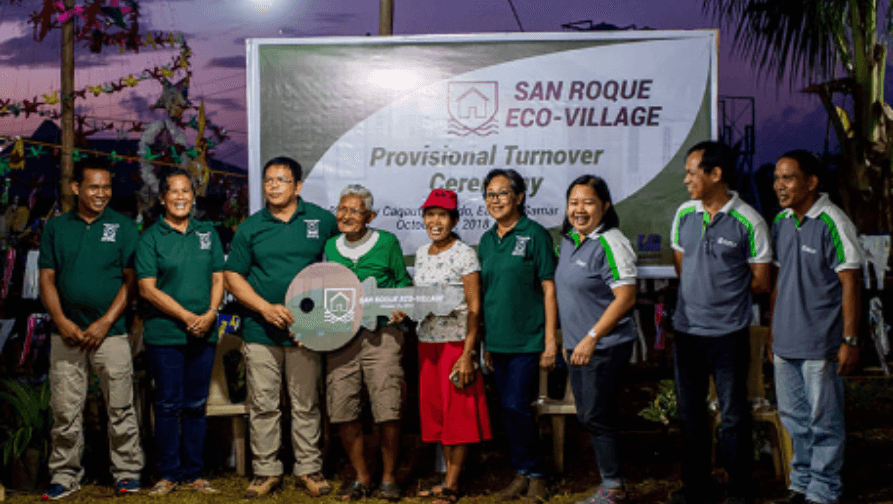
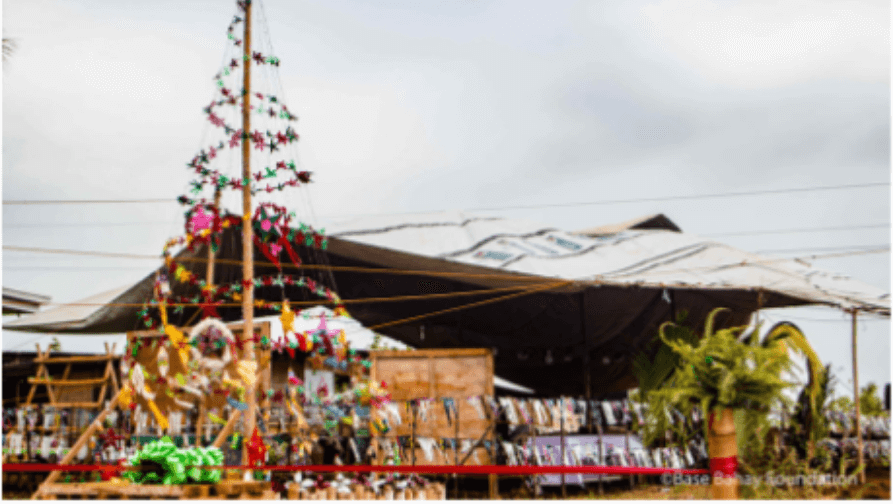
October 25 was like any other Thursday for most, but for families now residing in the San Roque Eco-Village in Salcedo, Cagaut Samar, it was a joyous occasion like no other. A total of 37 families were being given the keys to their new Cement Bamboo Frame Houses, permanent shelter a safe distance away from the disaster risk area they used to live in.

The San-Roque Eco-village is a project led by the Environmental Science for Social Change (ESSC), in partnership with Base Bahay Foundation, Inc., and the local government (LGU) of Cagaut, Salcedo. The Eco-village is a post-Haiyan effort aimed at relocating families living in at-risk areas of Cagaut to safer, more permanent land and homes. Through close community involvement and collaboration, 37 Cement Bamboo Frame houses were built complete with water and electrical systems.

Prior to moving, many of the beneficiaries of the project resided in a lower part of Cagaut, near a creek. While the creek served as a dock for many of communities’ fishermen and women, it also brought in frequent and destructive flooding due to yearly rains and typhoons. Samar itself is highly vulnerable to typhoons because it is a coastal area within the typhoon highway of the Philippines.

More than one celebration

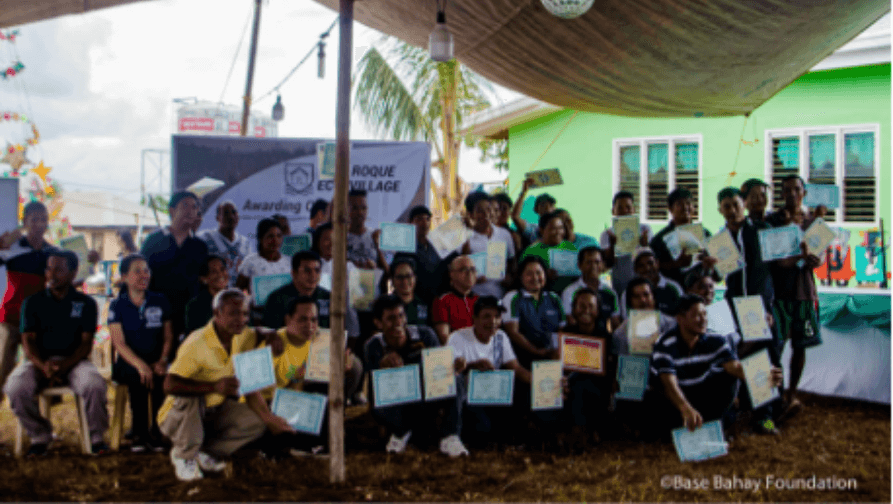
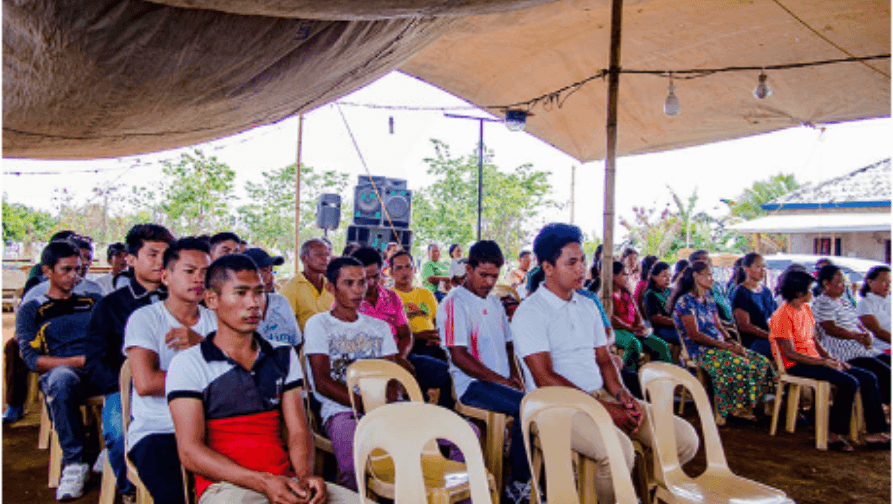
It was one celebration after another. The house turn-over celebration was preceded by another celebration: 28 trainees graduated and were awarded with certification for National Certification II in carpentry and masonry given by tesda, while 48 graduated from the Technical Vocational Educational training program also of TESDA (Technical Education and Skills Authority).

“The carpentry and masonry skills you have learned here will not be limited to Salcedo. These are skills you can carry on with you and help you with your employment wherever you go”, Tesda representative Rolando Juanello said. Accreditation for masonry and carpentry is timely, given that the current administration is pushing for a “build build build” program, thus creating an above average demand for construction and masonry work, the very skills they were given accreditation for.

The Training and certification program is one of the project’s defining characteristics. The Cement Bamboo Frame technology project process includes training the locally hired labor not just for bamboo building, but for conventional carpentry and masonry as well. With this in mind, ESSC led the partnership formation with the local government and TESDA, thus formalizing the training and certification program
Mayor Mergal said in his speech for the certification graduation. The Mayor urged the graduates to make sure they put their new skills to use, emphasizing that he did not like the idea of seeing their certificates displayed in your house, unused. “I hope this [graduation] is not the end. Continue!” He then praised the women who also got certified, and explained that the certification opens many doors for them, like the job fairs at the munisipyo.

After the certificate awarding ceremony, it was time for the turn-over. Names of the families were called and they came up and receive their keys, families glowing with pride and fulfillment. Many of the houses they received, they themselves helped build. After a day of celebrating achievements and receiving the new responsibilities to carry on further, the festivities came to a close.

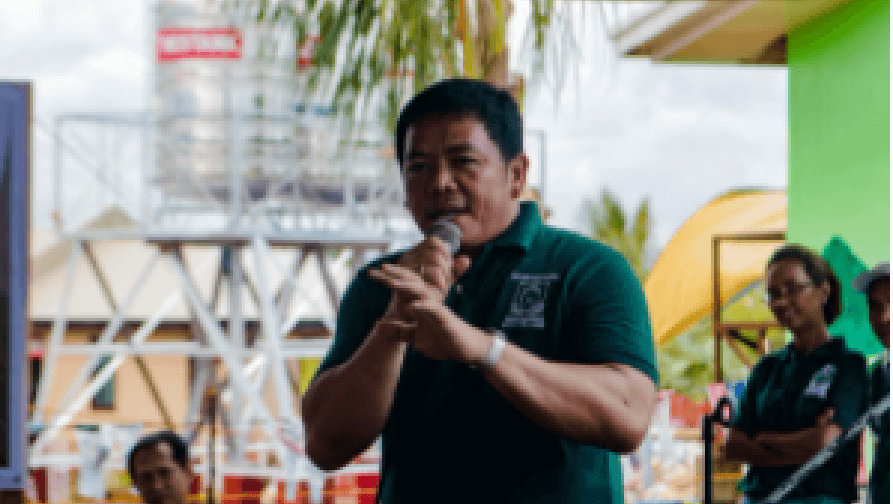
Base Bahay Head of project Management, Fred Silisilon Jr. ended the ceremony with a challenge for the new residents. “Today, in Cagaut, there are 37 families who will be receiving their houses; whose dreams of a better life will now take their first steps. [The houses] may go beyond 25 years because it was derived from a technology where houses stay beyond 200 years, but the durability of these houses [is] very reliant on the owners. Our challenge to you is to take care of them so they will last, not just for your benefit but also for the benefit of the future generations.”

For many of the residents of the Eco-Village, this is the first permanent house they will live in, one that is safe from the yearly rains. The appreciation is especially evident in the coming Christmas season which is usually the rainy season for Salcedo.