Author: Base

Base Bahay, Vincentian Foundation unveil Bamboo-Based Social Enterprise Center in Quezon City

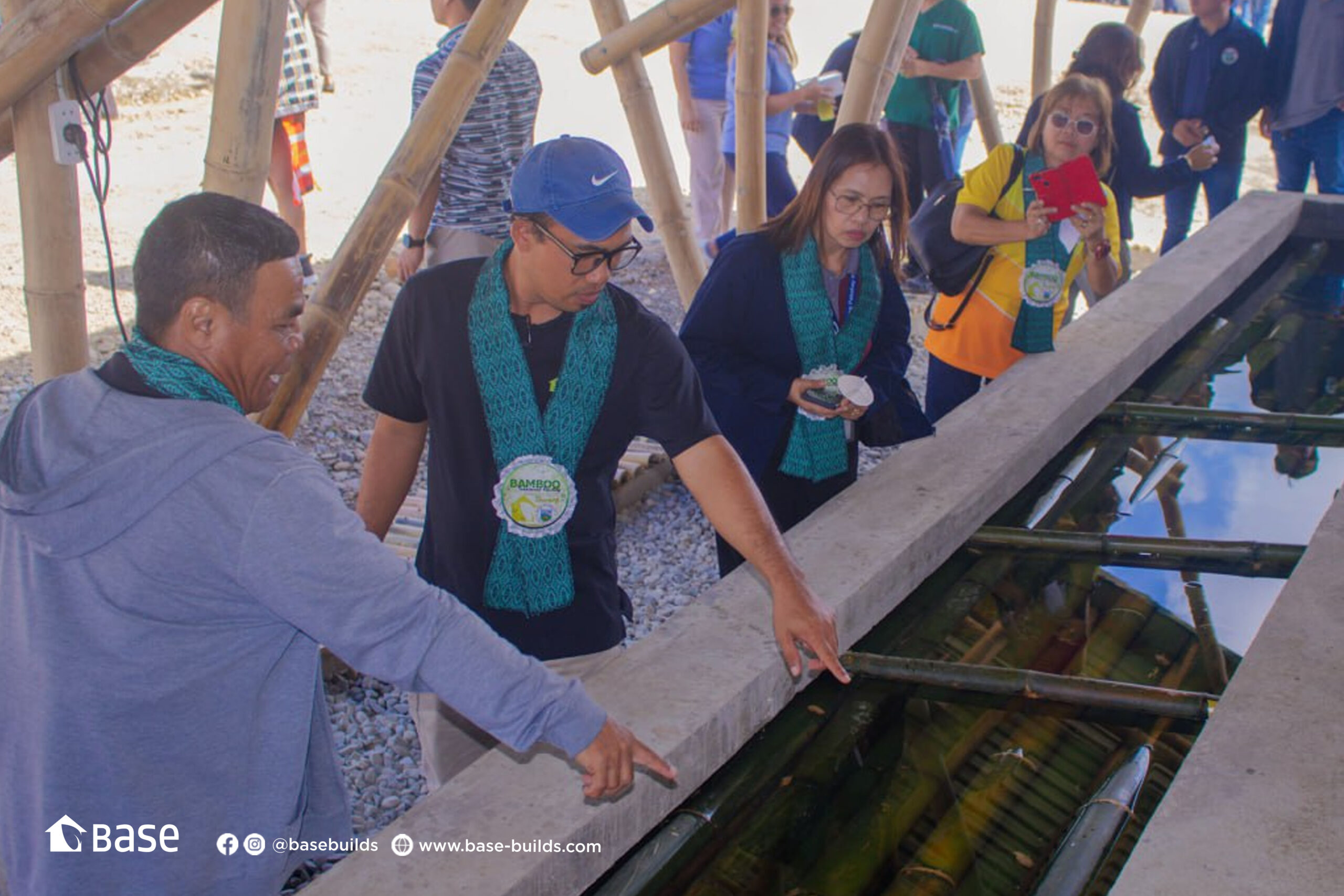
Through the collaboration between Base Bahay Foundation Inc., and Vincentian Missionaries Social Development Foundation Inc., the community of Bagong Silangan in Quezon City has welcomed a social enterprise center that showcases not only economic empowerment but also alternative building technologies.

Called the Vincentian Social Enterprise Center, this 71-sqm innovative bamboo-based facility is Base Bahay’s second special Cement-Bamboo Frame Technology (CBFT) structure that will open doors for more job and livelihood opportunities for the local community.

The structure, with eight (8) stalls, each with roughly 8.41 sqm floor area, is a blueprint for sustainable architecture, highlighting the potential of bamboo structures to seamlessly integrate within urban landscapes.

The center’s distinctive design features a long gable roof, supported by wing-like diagonal struts that extend from the studs to the roof frames, blending aesthetics and functionality.

“By building this center, we want community members to be empowered enough to provide food on the table for their families while showcasing how CBFT serves as a holistic solution for the global housing gap, climate change, and socio-economic challenges faced by our country,” said BASE President and Hilti Foundation Asia Liaison Maricen Jalandoni.

“We are building more than just durable homes. We are also fostering hope within the communities we support. We aspire to help families sustainably. Through our collaborations, we are empowering them to attain economic independence,” Maricen added.

BASE, a non-profit organization initiated by the Hilti Foundation, provides alternative building technologies that enable a network of partners to build comfortable, affordable, disaster-resilient, and environment-friendly structures with social impact.

To date, BASE has built over 1,200 homes in 15 communities in the Philippines, over 400 homes in four (4) communities in Nepal, and two (2) model houses in India. It also has six (6) bamboo supply facilities across the country and another in Mindanao that is currently in the construction phase.

The Center is part of a larger program by BASE to construct bamboo structures within the community in Quezon City, complementing the existing 50 housing units and the recently completed community center serving as a post-harvest facility.

Part of these initiatives is the Planting for Productivity Project (P4P), a collaborative effort involving BASE, Hilti Foundation, Ayala Foundation Inc., and the Quezon City Government, to build a more food-secure future for households and communities through urban farming.

The P4P is strategically divided into two phases—AgriKaya, which focuses on empowering households through home-based farming, promoting self-sufficiency and healthy eating habits, and AgriKita, which aims to spur urban farming and entrepreneurship to offer livelihood opportunities to households.

These undertakings can provide a big boost to marginalized communities, especially in the face of minimum wages falling short for families of five to meet basic needs. Studies have shown the significance of urban farms in providing families with a steady and practical supply of nutritious food.

“We are grateful for this partnership with BASE as this gives more meaning to efforts of pushing the boundaries of traditional construction. It also proves that when organizations collaborate, we can do more to empower communities and foster self-sufficiency, creating a ripple effect of positive change,” said Fr. Mario Castillo, Vincentian Foundation Executive Director.

Base Bahay Foundation Welcomes Engr. Luis Felipe Lopez as New General Manager

On July 1, 2024, Engr. Luis Felipe Lopez took over as the new General Manager of Base Bahay (BASE) succeeding Dr. Pablo Jorillo, who transitioned to a Senior Consultancy role with the foundation.  Under Dr. Jorillo’s leadership, BASE has achieved numerous milestones, laying the groundwork for Base’s Vision in bamboo and sustainable construction.

BASE was initiated by the Hilti Foundation to provide alternative building technologies using locally grown and renewable materials to create housing envelopes and designs suited to the needs of local communities.  Already, Base has enabled a network of partners to build quality socialized homes for over 10,500 individuals that are sustainable, disaster-resilient, and comfortable using BASE’s Cement-Bamboo Frame Technology while providing livelihood to countless more. 

A native of Colombia and a Civil Engineer who graduated from the Universidad Nacional de Colombia (2000), Luis moved to the Philippines in 2014 to take on the role of BASE’s Head of Product Development for Bamboo Housing. Previous to his appointment with BASE, he had worked with the Hilti Foundation as a consultant in 2012 and 2013.  His role transitioned to Head of Technology and Director of the Base Innovation Center (BIC) where research, training, and application of BASE’s Cement-Bamboo Frame Technology in the Philippines continues.

Today, Luis has been instrumental in efforts to promote the creation of our own National Structural Code for Bamboo together with the Association of Structural Engineers of the Philippines (ASEP.   At the Base Innovation Center in Makati which he manages, BASE continues to conduct research and leverage technology to innovate and bring Bamboo into mainstream construction as a sustainable and reliable building material.  

He is one of the authors of the Colombian Bamboo Structural Design Code NSR-10 and collaborated actively in the development of the Peruvian and Ecuadorian bamboo Codes as well. Currently, He is part of the ISO Committee TC 165 (Timber and bamboo structures) representing Colombia, where he worked keenly on the update of the ISO 22156 “Bamboo structural design” standard, published in June 2021. He is also the newly appointed Co-Chair for the National Structural Code of the Philippines (NSCP) 8th Edition, 2022 – Chapter 8 Bamboo Volume I.

“For 10 years, we have witnessed the growth of BASE from building houses to different structures. We have seen how our network of partners has grown to one where we collaborate with different organizations around the world. From a bamboo research and testing center, the Base Innovation Center has transitioned to an internationally accredited laboratory and is now a global leader in bamboo construction,” says Luis.

“With our dedicated team and strong partners, we at BASE will continue to work toward our shared vision of becoming a leading competent global center and scale up bamboo construction to provide underserved families with a safe place to live in.”

This transition marks a new chapter for BASE as the foundation continues to innovate, enable, and build stronger communities in the Philippines and beyond.

BASE Celebrates a Decade of Success in Enabling Bamboo Construction

28 July 2024, Manila. Base Bahay Foundation, Inc. (BASE), the global leader in Bamboo Construction, marks its 10th year of building resilient bamboo infrastructure for the Philippines and beyond. Central to the BASE milestone celebration is a pledge to use its anniversary resources to build more comfortable, affordable, disaster-resilient, and environment-friendly homes for underserved families – a gesture that supports the organization’s goal at its founding by the HILTI Foundation in July 2014 to help address the growing housing gap and reduce the effect of climate change by using local and sustainable materials.

“Together over the last decade, BASE and the Hilti Foundation have worked to elevate the living standards of every family in the community and enable them to have a sustainable future,” says Maricen Jalandoni, BASE President and Hilti Foundation Asia Liaison. “We can think of no better way to celebrate than to bring sustainable shelter to more families.”

Adds Engr. Luis Felipe Lopez, BASE General Manager: “The 2023 UN-Habitat PH Country Report estimates that the Philippines will be saddled with a 22-million housing backlog by 2040. Together with our network of partners, we are putting our BASE Cement-Bamboo Framework to scale as a holistic solution to the global housing gap, climate change, and socioeconomic challenges.”

“Central to our short-term goals is our work to include Bamboo in the National Structural Code for construction that will then allow us to leverage the abundance of bamboo across the country to build more sustainable, resilient, and affordable housing solutions.”

Across the BASE organization, three key pillars define the work: BASE Innovates where as a leading global authority, BASE works with top local and international universities to develop alternative building technologies and design innovations; BASE Builds under which sustainable, resilient, and affordable solutions are developed to address the global housing crisis while also providing an inclusive better future for all; and BASE Enables which pertain to the building of a robust ecosystem for scalable housing solutions that in turn creates a network of bamboo enterprises that drive industry growth and impact.

BASE Innovates

When the BASE Innovation Center in Makati City was inaugurated in 2021 it paved the way for more international and local research collaboration. Today, as a global competence center, over 5,000 tests run at the Base Innovation Center have provided important data to the publication of over 20 papers in scientific journals and the work BASE continues to carry out in partnership with seven (7) local universities and nine (9) international academic institutions. This has resulted in BASE’s accreditation with RILEM (Réunion Internationale des Laboratoires et Experts des Matériaux, systèmes de construction et ouvrages) this year. RILEM is a global network of laboratories and experts in construction materials, systems, and structures.

The testing and research at the Base Innovation Center also provide critical information that supports ongoing efforts together with the Association of Structural Engineers of the Philippines (ASEP) to include bamboo in the National Structural Code of the Philippines (NSCP). With these results, BASE also supports the development of bamboo codes in Nepal and the latest revision of bamboo codes in Colombia.

BASE Enables

The organization’s education outreach in sustainable construction will continue to be key to achieving BASE’s goals. Through the organization’s Continuing Professional Development (CPD) Program under the Bamboo Academy, professional architects and civil engineers earn CPD units that they need for their continued development. To date, Base has conducted 15 online and in-person CPD Programs and trained over 2,000 workers and professional builders.

Just last June, BASE hosted a third in a series of annual bamboo conferences termed “Bamboost” Forum themed Beyond Bamboo: Bridging Green Construction in Codes and Standards”. Bamboost III was a leveled-up event that brought together local and international bamboo experts and partners in sustainable construction who shared their expertise to educate, motivate, and inspire professional builders and bamboo enthusiasts.

Enabling ongoing builds and providing livelihood to communities are six (6) bamboo supply and treatment partners across the Philippines with two more facilities scheduled for completion within the year. Last year, Base established a Quality Management System to improve the services these partners provide and ensure that they meet clients’ needs and demands.

BASE Builds

Supported by all these initiatives, BASE and their partners have built over 2,300 homes in over 20 communities across the Philippines, Nepal, India, Sri Lanka, and Nicaragua, sheltering around 10,500 individuals. In 2019, BASE started the Negros Occidental Impact 2025 in partnership with Habitat for Humanity Philippines, which is its biggest housing project to date.

Beyond housing, BASE has built 14 special structures, which include a children’s home, an office, a weaving center, community centers, and school buildings which are accredited by the Department of Education (DepEd).

In 2023, Base Bahay started the integration of Excellence in Design for Greater Efficiencies (EDGE) green building certification on its projects. EDGE is a green building certification system and a sustainability platform developed by the International Finance Corporation. This certification program encourages property developers to design and construct more energy and water-efficient buildings using sustainable materials. It also aims to reduce buildings’ carbon footprint and promote resource conservation. Currently, BASE has five EDGE-certified experts.

When it comes to the organization’s environmental impact, BASE has an average of 35,000 tCO2 savings from the houses built using Cement-Bamboo Frame Technology (CBFT).

Composite bamboo shear walls – A shear wall system for affordable and sustainable housing in tropical developing countries

Authors

Sebastian Kaminski

Luis Felipe López

David J A Trujillo

Edwin Zea Escamilla

Verónica Correa-Giraldo

Juan Correal-Daza

Abstract

Composite bamboo shear walls (CBSW) are modern engineered vernacular-improved shear walls, that take the traditional Latin American wattle-and-daub known as bahareque, and engineer it, using modern materials and construction techniques. CBSWs consist of a frame made of timber and/or large-diameter bamboo, upon which a matrix of cane, small-diameter bamboo, flattened bamboo, bamboo laths, or expanded steel mesh is nailed. The walls are then finished with cement or lime render to form solid shear walls. Over the past 30 years, at least 4000 one and two-storey homes utilizing modern CBSWs have successfully been constructed in various countries around the world, including Costa Rica, Colombia, Nepal, Ecuador, Peru, Mexico, El Salvador, and the Philippines. When properly designed and built, they have demonstrated their effectiveness as an affordable, hazard-resilient, low-carbon, and durable form of housing. The system is now codified in the Colombian, Ecuadorian, and Peruvian structural standards, as well as in ISO 22156. Efforts are currently underway to incorporate them into the Philippines, Mexican, and Nepalese codes. This paper describes the history of the CBSW system, variations that exist across the world, the current state of knowledge with regard to codes, strength, ductility, sustainability, and fire, and recommendations for areas of future research. The paper argues that the CBSW system is an effective way of creating low-carbon housing that provides excellent code-compliant strength, ductility, and durability, and has significant potential for affordable housing in lower and middle-income highly seismic countries where bamboo grows.

Bridging Housing and Climate Needs: Bamboo Construction in the Philippines

Authors

Timo Bundi

Luis Felipe Lopez

Guillaume Habert

Edwin Zea Escamilla

Abstract

The Philippines faces a significant shortage of affordable housing, and with the growing
urgency brought by climate change, there is a pressing need for more sustainable and affordable
building solutions. One promising option is cement bamboo frame buildings, which blend traditional
bamboo building methods with modern materials. This approach is already being implemented
in social housing projects in the Philippines. Dynamic lifecycle assessment (DLCA) calculations
show that these bamboo buildings can effectively reduce overall CO2 emissions. Before a building’s
end of life, biogenic effects offset approximately 43% of its total production emissions, while the
temporary carbon storage afforded by these biogenic materials further reduces total emissions by
14%. In comparison to concrete brick buildings, bamboo constructions reduce emissions by 70%.
Transforming an unmanaged bamboo plantation into a managed plantation can potentially triple
the capacity for long-term CO2 storage in biogenic materials and further reduce net emissions by
replacing concrete with bamboo as the main construction material. Thus, bamboo construction offers
a potent, economically viable carbon-offsetting strategy for social housing projects.

Experimental Study on the Dowel-Bearing Strength of Bambusa blumeana Bamboo Used for SustainableHousing Construction

Authors

Cres Dan O. Bangoy, Jr.

Jedelle Y. Falcon

Hannah Amyrose F. Lorenzo

Steven Royce A. Zeng

Lessandro Estelito O. Garciano

Carlo Joseph D. Cacanando

Abstract

This study addresses the critical issue of dowel-bearing strength in Bambusa blumeana,
a key sustainable construction material crucial for climate change mitigation. Given the lack of
bamboo connection standards, this research focuses on determining the dowel-bearing strength of
Bambusa blumeana, emphasizes factors such as dowel diameter, node placements, and the physical
properties of bamboo. A predictive equation is derived, enhancing the practicality of bamboo in
structural design. The results underscore a notable correlation between dowel diameter and characteristic strength, with implications for engineering practices. Node placements significantly affect
dowel-bearing capacity, while bamboo’s physical attributes, including thickness, culm diameter, and
moisture content, exhibit modest correlations with strength. The derived equation aims to assist
in structural design, mitigating splitting and bearing failures in bamboo structures. This research
establishes a foundation for optimizing the use of Bambusa blumeana in sustainable construction,
advancing the understanding of its dowel-bearing strength for improved sustainability and resilience
in the construction industry. Future research suggestions include exploring bamboo–mortar composites, additional node placements, and employing more comprehensive empirical equations and
curve-fitting techniques. The study advocates for further investigations with more diverse and
larger bamboo samples to bolster robustness. Additionally, delving into bamboo ductility may offer
valuable insights.