Onsite Bending Test: Bridging the Gap Between Field and Laboratory

Overview

Reliable structural data is the foundation of every safe, sustainable bamboo building. To support this, the Base Innovation Center has developed a standardized toolkit that brings professional-grade testing directly to your project site. For projects located in remote areas or those requiring efficient, on-site material validation, this toolkit offers a practical, ISO-compliant methodology for evaluating the mechanical properties of bamboo culms. By streamlining the testing process, this resource ensures that structural assessment remains both rigorous and accessible.

Resource Components:

  • Technical Manual: Covers the full workflow from harvesting with grading of bamboo poles to geometric characterization and the 4-point bending test protocol.
  • Rig Schematics: Includes an item checklist and engineering drawings for the components and assembly of the test rig.
  • Analysis Spreadsheet: A pre-formatted tool to input load and displacement data to easily calculate the Modulus of Elasticity and Bending Strength
  • Video Walkthrough: Demonstrates the physical setup of the 4-point bending test

Technical Manual

Rig Schematics

Analysis Spreadsheet

Disclaimer: This spreadsheet is provided for reference and general guidance only. It is intended to assist qualified professionals in performing field testing (bending test) and should not be considered a substitute for sound engineering judgment or professional expertise. All inputs, outputs, assumptions, and interpretations derived from this tool are the sole responsibility of the user. It is the user’s duty to ensure that all designs comply with applicable building codes, local regulations, site-specific conditions, and project requirements.

While reasonable efforts have been made to ensure the accuracy of this spreadsheet, Base Bahay Foundation, Inc. makes no warranties, express or implied, regarding its completeness, accuracy, or fitness for a particular purpose. Base Bahay shall not be held liable for any loss, damage, or consequence arising from the use, misuse, or reliance on this spreadsheet or its results. By using this spreadsheet, the user agrees to release, indemnify, and hold harmless Base Bahay Foundation, Inc., its affiliates, officers, employees, and consultants from any and all claims or liabilities related to its use. Use at your own risk.

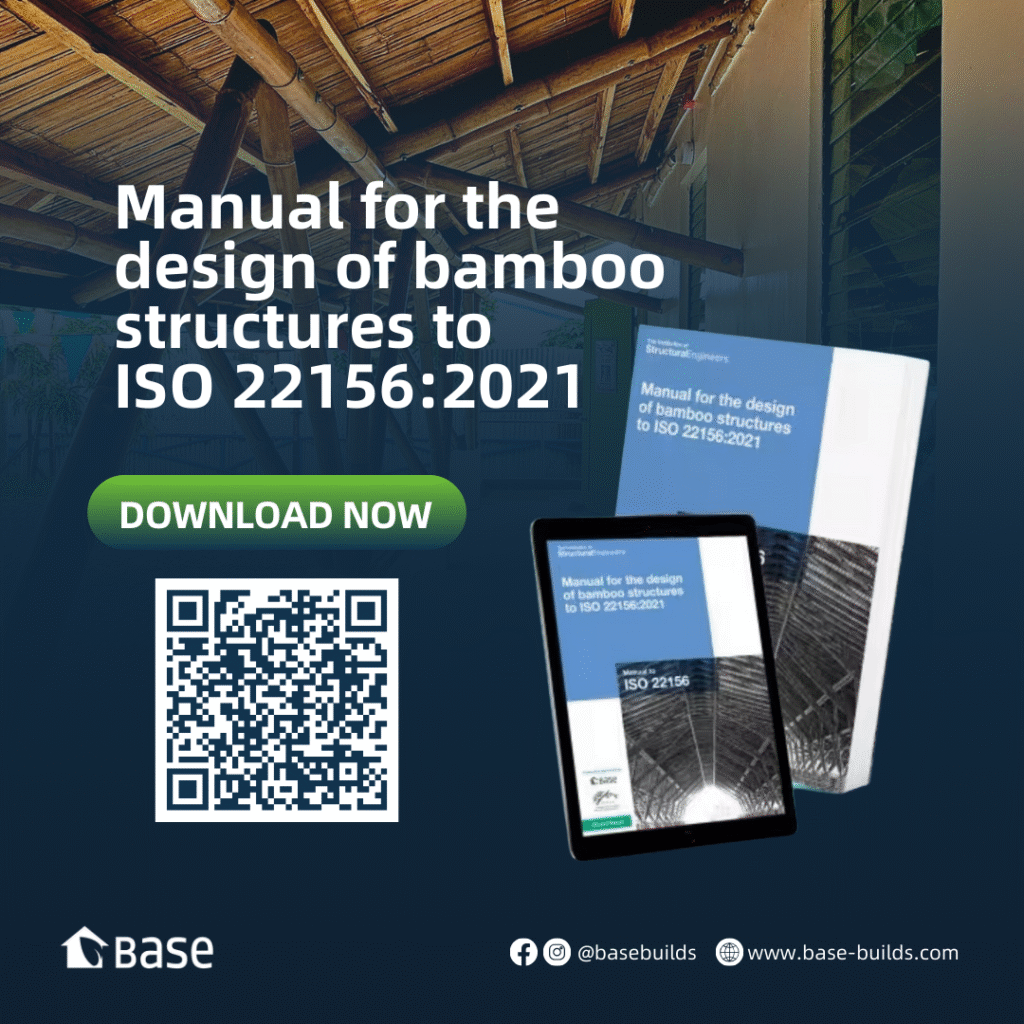
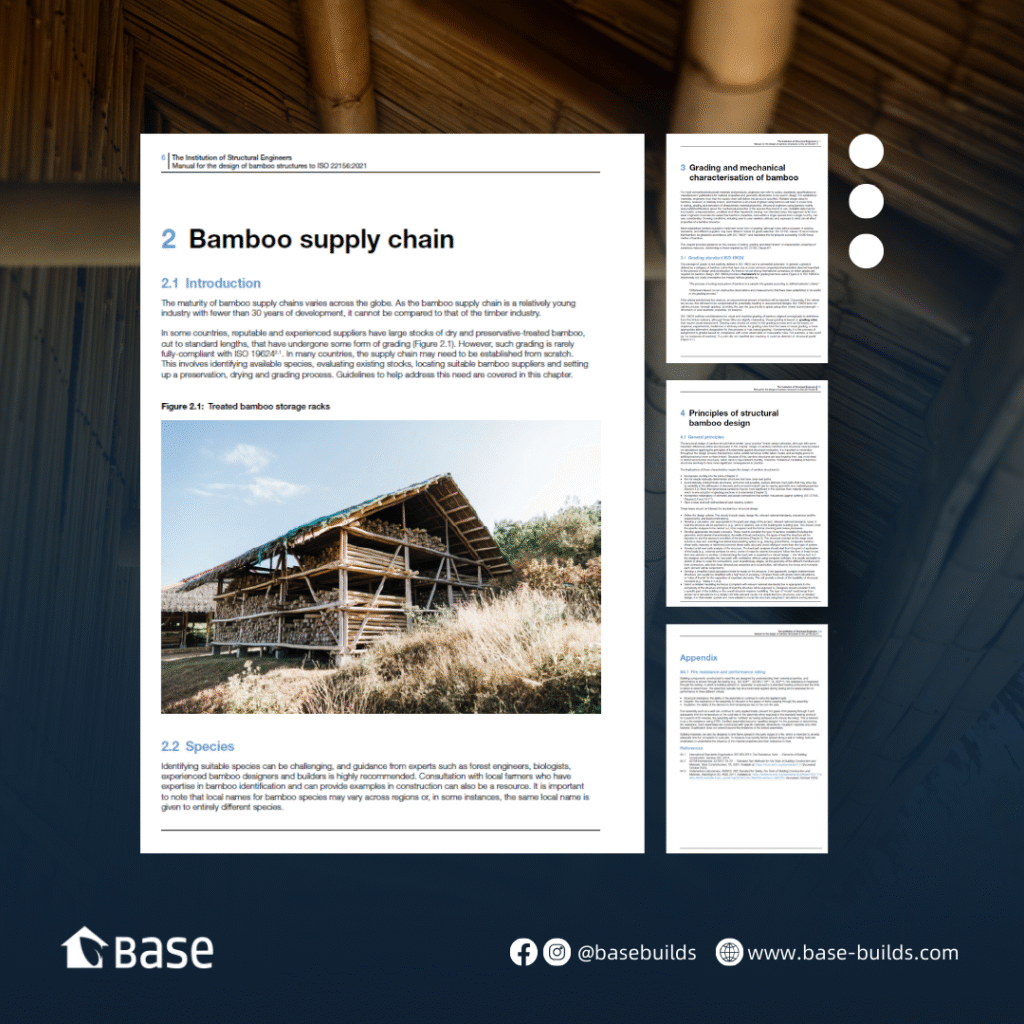
Manual for the Design of Bamboo Structures to ISO 22156:2021

Authors

  • Dr David Trujillo CEng, Assistant Professor in Humanitarian Engineering, School of Engineering at the University of Warwick;
  • Kent Harries PEng, Professor of Structural Engineering and Mechanics, University of Pittsburgh;
  • Sebastian Kaminski CEng, an IStructE Fellow and a structural engineer from consulting firm Arup;
  • Engr. Luis Felipe Lopez CEng, General Manager of the Base Bahay Foundation Inc. (BASE), which is a guide sponsor with the International Bamboo and Rattan Organization (INBAR).

Overview

Manual for the design of bamboo structures to ISO 22156:2021 aims to help structural engineers and other architecture, engineering, and construction (AEC) professionals understand how this prolific bio-based material can be used safely, with the ISO standard and the manual limited to two-storeys because of fire concerns.

Bamboo Construction Manual For Single-Story Housing

Authors

Base Bahay Foundation, Inc.

International Bamboo and Rattan (INBAR) Organization

Overview

This manual provides a detailed guide of how to construct a single-story bamboo house using a Composite Bamboo Shear Wall (CBSW) system. The CBSW system is an innovative construction method that integrates full bamboo culms with modern connection techniques and is protected with exterior plastering material. This guide outlines a step-by-step process, from the production of treated and structurally graded bamboo culms and the prefabrication of CBSW components to the prefabrication of roof trusses, ensuring high quality control. Site preparation and foundation work can be conducted in parallel, streamlining the process and allowing for rapid installation of structural systems on-site. The subsequent chapters provide a guide to the roofing, plastering, and finishing.

In addition, this guideline details best practices, common pitfalls, and key considerations when seeking to effectively use structurally graded bamboo in housing construction. Note that this manual is specific to single-story housing and does not cover other types of structures.

Design, Build and Preservation: An Innovative Bamboo Treatment for Industrial Building Use

Authors

Dr. Jean-Luc Kouyoumji

Dr. Eric Heisel

Luis Lopez

Abstract

Building with bio-sourced material is an emerging industry that can make a high contribution to the reduction of GHG emissions and help to unlock the low-carbon, circular economy. Bamboo is a very interesting bio-sourced material for construction. Since years, bamboo is demonstrating a very nice alternative to mineral materials. By maximising the use of bio-sourced in new built and renovation through optimal hybrid solutions with other materials, the built environment can be transformed into a large-scale carbon sink. However, unlocking the potential of bio-sourced as both a sustainable building material and climate solution (the ‘natural-carbon-pump’) requires a stronger focus on the bio-sourced construction chains and the whole innovation ecosystem.
First, we will talk about the building value chain for different products and building systems. Comparison will be made with wood industry using engineered wood products (EWP) for the latest developments of high-rise wooden buildings. Authors will show that building with innovative material such as bamboo and engineered bamboo products (EBP) is only a matter of regulations, engineering capacities and implementation methods.
Second, we will focus on bamboo treatment showing some relevant results coming from the Philippines. We will show case of an innovative bamboo treatment implemented at a country scale in the Philippines that is turning today international, with the Base Bahay Foundation of the Hilti Foundation. The project concerns building with bamboo quality socialized homes. Homes that are comfortable, affordable, disaster resilient, ecologically friendly, and with social impact.
Bamboo is known to be difficult to treat due to its high resistance to impregnation. Soaking – diffusion gives some efficiency for needed bamboo preservation rate, as well as for the intensive productivity rate. Alternative solution to the use of traditional treatment products for bamboo poles treatment was investigated and an innovative methodology was successfully implemented in 5 sites in the Philippines, supplying bamboo for housing projects. We will show how a treatment facility has to be designed for workers safety, for environment safety, for bamboo material efficiency, and for product quality control. The treatment procedure is composed of 15 necessary steps to be followed. BSInnovations is the body responsible of the invention, the installation and the technical validation of the treatment facility.

Composite bamboo shear walls – A shear wall system for affordable and sustainable housing in tropical developing countries

Authors

Sebastian Kaminski

Luis Felipe López

David J A Trujillo

Edwin Zea Escamilla

Verónica Correa-Giraldo

Juan Correal-Daza

Abstract

Composite bamboo shear walls (CBSW) are modern engineered vernacular-improved shear walls, that take the traditional Latin American wattle-and-daub known as bahareque, and engineer it, using modern materials and construction techniques. CBSWs consist of a frame made of timber and/or large-diameter bamboo, upon which a matrix of cane, small-diameter bamboo, flattened bamboo, bamboo laths, or expanded steel mesh is nailed. The walls are then finished with cement or lime render to form solid shear walls. Over the past 30 years, at least 4000 one and two-storey homes utilizing modern CBSWs have successfully been constructed in various countries around the world, including Costa Rica, Colombia, Nepal, Ecuador, Peru, Mexico, El Salvador, and the Philippines. When properly designed and built, they have demonstrated their effectiveness as an affordable, hazard-resilient, low-carbon, and durable form of housing. The system is now codified in the Colombian, Ecuadorian, and Peruvian structural standards, as well as in ISO 22156. Efforts are currently underway to incorporate them into the Philippines, Mexican, and Nepalese codes. This paper describes the history of the CBSW system, variations that exist across the world, the current state of knowledge with regard to codes, strength, ductility, sustainability, and fire, and recommendations for areas of future research. The paper argues that the CBSW system is an effective way of creating low-carbon housing that provides excellent code-compliant strength, ductility, and durability, and has significant potential for affordable housing in lower and middle-income highly seismic countries where bamboo grows.

Bridging Housing and Climate Needs: Bamboo Construction in the Philippines

Authors

Timo Bundi

Luis Felipe Lopez

Guillaume Habert

Edwin Zea Escamilla

Abstract

The Philippines faces a significant shortage of affordable housing, and with the growing
urgency brought by climate change, there is a pressing need for more sustainable and affordable
building solutions. One promising option is cement bamboo frame buildings, which blend traditional
bamboo building methods with modern materials. This approach is already being implemented
in social housing projects in the Philippines. Dynamic lifecycle assessment (DLCA) calculations
show that these bamboo buildings can effectively reduce overall CO2 emissions. Before a building’s
end of life, biogenic effects offset approximately 43% of its total production emissions, while the
temporary carbon storage afforded by these biogenic materials further reduces total emissions by
14%. In comparison to concrete brick buildings, bamboo constructions reduce emissions by 70%.
Transforming an unmanaged bamboo plantation into a managed plantation can potentially triple
the capacity for long-term CO2 storage in biogenic materials and further reduce net emissions by
replacing concrete with bamboo as the main construction material. Thus, bamboo construction offers
a potent, economically viable carbon-offsetting strategy for social housing projects.