Tag: Sustainable Housing

Manual de Construcción con Bambú para Vivienda de Un Piso (Bamboo Construction Manual For Single-Story Housing Spanish Edition)

Authors

La Fundación Base Bahay (Base Bahay Foundation, Inc.)

Organización Internacional del Bambú y Ratán (International Bamboo and Rattan Organization)

Overview

Este manual ofrece una guía detallada para la construcción de una vivienda de bambú de un piso utilizando el sistema de muros estructurales de bambú compuesto (MEBC o bahareque encementado). Este sistema constituye un método de construcción innovador que combina culmos de bambú completos con técnicas modernas de conexión y un revestimiento exterior de protección. La guía presenta el proceso paso a paso: desde la producción de culmos tratados y clasificados estructuralmente, hasta la prefabricación de los componentes del MEBC y de las cerchas de cubierta, garantizando altos estándares de control de calidad. La preparación del terreno y los trabajos de cimentación pueden ejecutarse de manera paralela, lo que agiliza el proceso constructivo y permite una instalación rápida y eficiente de los sistemas estructurales en obra. Los capítulos posteriores ofrecen instrucciones detalladas para la instalación de la cubierta, el revestimiento y los acabados.

Además, este manual reúne las mejores prácticas, los errores comunes y las consideraciones clave para el uso eficaz del bambú clasificado estructuralmente en la construcción de viviendas. Es importante señalar que su alcance se limita a edificaciones de un solo piso y no abarca otros tipos de estructuras.

Aviso legal:

INBAR y BASE no se harán responsables por el mal uso y la mala interpretación de las directrices presentadas en este documento.

Experimental Characterization of Composite Bamboo ShearWall Panels Under Monotonic and Cyclic Loading

Authors

  • Mary Joanne C. Aniñon
  • Mees C. Fabel
  • Lessandro Estelito O. Garciano
  • Luis Felipe Lopez
  • Nischal P. N. Pradhan

Abstract

The escalating global demand for sustainable and disaster-resilient housing has renewed interest in bamboo-based construction systems, particularly composite bamboo shear wall (CBSW) panels as low-carbon alternatives to conventional materials. Despite their potential, systematic data on the shear performance of such panels remains limited, especially regarding the influence of cross-bracing on strength, stiffness, ductility, dissipated energy, and damage behavior under lateral loading. This study addresses this gap through experimental characterization of full-scale CBSW panels. Two configurations, with (WT1) and without (WT2) flat steel bar cross-bracing, were tested under monotonic and cyclic loading. WT1 panels consistently exhibited a higher characteristic shear strength and capacity, and initial stiffness than WT2. WT2 panels showed greater ductility through more distributed deformation. Both configurations displayed gradual strength deterioration postpeak. The Energy Equivalent Elastic–Plastic (EEEP) method yielded higher and more conservative estimates of yield load and displacement compared to the conventional approach. These findings demonstrate that CBSW panels, particularly WT1, offer viable lateral resistance for low-rise structures in seismic-prone regions.

Manual for the Design of Bamboo Structures to ISO 22156:2021

Authors

  • Dr David Trujillo CEng, Assistant Professor in Humanitarian Engineering, School of Engineering at the University of Warwick;
  • Kent Harries PEng, Professor of Structural Engineering and Mechanics, University of Pittsburgh;
  • Sebastian Kaminski CEng, an IStructE Fellow and a structural engineer from consulting firm Arup;
  • Engr. Luis Felipe Lopez CEng, General Manager of the Base Bahay Foundation Inc. (BASE), which is a guide sponsor with the International Bamboo and Rattan Organization (INBAR).

Overview

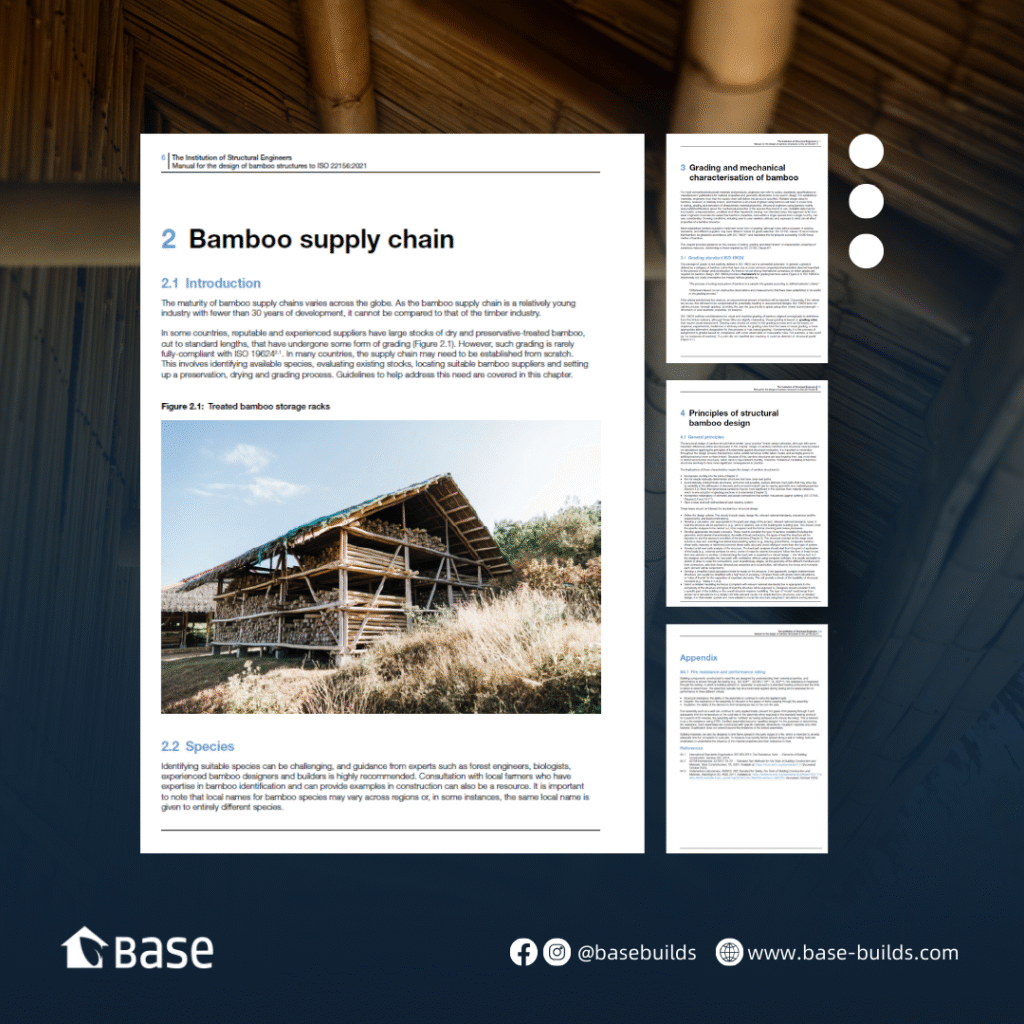
Manual for the design of bamboo structures to ISO 22156:2021 aims to help structural engineers and other architecture, engineering, and construction (AEC) professionals understand how this prolific bio-based material can be used safely, with the ISO standard and the manual limited to two-storeys because of fire concerns.

Bamboo Construction Manual For Single-Story Housing

Authors

Base Bahay Foundation, Inc.

International Bamboo and Rattan (INBAR) Organization

Overview

This manual provides a detailed guide of how to construct a single-story bamboo house using a Composite Bamboo Shear Wall (CBSW) system. The CBSW system is an innovative construction method that integrates full bamboo culms with modern connection techniques and is protected with exterior plastering material. This guide outlines a step-by-step process, from the production of treated and structurally graded bamboo culms and the prefabrication of CBSW components to the prefabrication of roof trusses, ensuring high quality control. Site preparation and foundation work can be conducted in parallel, streamlining the process and allowing for rapid installation of structural systems on-site. The subsequent chapters provide a guide to the roofing, plastering, and finishing.

In addition, this guideline details best practices, common pitfalls, and key considerations when seeking to effectively use structurally graded bamboo in housing construction. Note that this manual is specific to single-story housing and does not cover other types of structures.

Design, Build and Preservation: An Innovative Bamboo Treatment for Industrial Building Use

Authors

Dr. Jean-Luc Kouyoumji

Dr. Eric Heisel

Luis Lopez

Abstract

Building with bio-sourced material is an emerging industry that can make a high contribution to the reduction of GHG emissions and help to unlock the low-carbon, circular economy. Bamboo is a very interesting bio-sourced material for construction. Since years, bamboo is demonstrating a very nice alternative to mineral materials. By maximising the use of bio-sourced in new built and renovation through optimal hybrid solutions with other materials, the built environment can be transformed into a large-scale carbon sink. However, unlocking the potential of bio-sourced as both a sustainable building material and climate solution (the ‘natural-carbon-pump’) requires a stronger focus on the bio-sourced construction chains and the whole innovation ecosystem.
First, we will talk about the building value chain for different products and building systems. Comparison will be made with wood industry using engineered wood products (EWP) for the latest developments of high-rise wooden buildings. Authors will show that building with innovative material such as bamboo and engineered bamboo products (EBP) is only a matter of regulations, engineering capacities and implementation methods.
Second, we will focus on bamboo treatment showing some relevant results coming from the Philippines. We will show case of an innovative bamboo treatment implemented at a country scale in the Philippines that is turning today international, with the Base Bahay Foundation of the Hilti Foundation. The project concerns building with bamboo quality socialized homes. Homes that are comfortable, affordable, disaster resilient, ecologically friendly, and with social impact.
Bamboo is known to be difficult to treat due to its high resistance to impregnation. Soaking – diffusion gives some efficiency for needed bamboo preservation rate, as well as for the intensive productivity rate. Alternative solution to the use of traditional treatment products for bamboo poles treatment was investigated and an innovative methodology was successfully implemented in 5 sites in the Philippines, supplying bamboo for housing projects. We will show how a treatment facility has to be designed for workers safety, for environment safety, for bamboo material efficiency, and for product quality control. The treatment procedure is composed of 15 necessary steps to be followed. BSInnovations is the body responsible of the invention, the installation and the technical validation of the treatment facility.

Composite bamboo shear walls – A shear wall system for affordable and sustainable housing in tropical developing countries

Authors

Sebastian Kaminski

Luis Felipe López

David J A Trujillo

Edwin Zea Escamilla

Verónica Correa-Giraldo

Juan Correal-Daza

Abstract

Composite bamboo shear walls (CBSW) are modern engineered vernacular-improved shear walls, that take the traditional Latin American wattle-and-daub known as bahareque, and engineer it, using modern materials and construction techniques. CBSWs consist of a frame made of timber and/or large-diameter bamboo, upon which a matrix of cane, small-diameter bamboo, flattened bamboo, bamboo laths, or expanded steel mesh is nailed. The walls are then finished with cement or lime render to form solid shear walls. Over the past 30 years, at least 4000 one and two-storey homes utilizing modern CBSWs have successfully been constructed in various countries around the world, including Costa Rica, Colombia, Nepal, Ecuador, Peru, Mexico, El Salvador, and the Philippines. When properly designed and built, they have demonstrated their effectiveness as an affordable, hazard-resilient, low-carbon, and durable form of housing. The system is now codified in the Colombian, Ecuadorian, and Peruvian structural standards, as well as in ISO 22156. Efforts are currently underway to incorporate them into the Philippines, Mexican, and Nepalese codes. This paper describes the history of the CBSW system, variations that exist across the world, the current state of knowledge with regard to codes, strength, ductility, sustainability, and fire, and recommendations for areas of future research. The paper argues that the CBSW system is an effective way of creating low-carbon housing that provides excellent code-compliant strength, ductility, and durability, and has significant potential for affordable housing in lower and middle-income highly seismic countries where bamboo grows.