Tag: Sustainable Housing

Environmental Performance of Social Housing in Emerging Economies: Life Cycle Assessment of Conventional and Alternative Construction Methods in the Philippines

Authors

Corinna Salzer
Holger Wallbaum, Chalmers University of Technology
York Ostermeyer, Chalmers University of Technology
Jun Kono, Deloitte Tohmatsu Consulting

Abstract

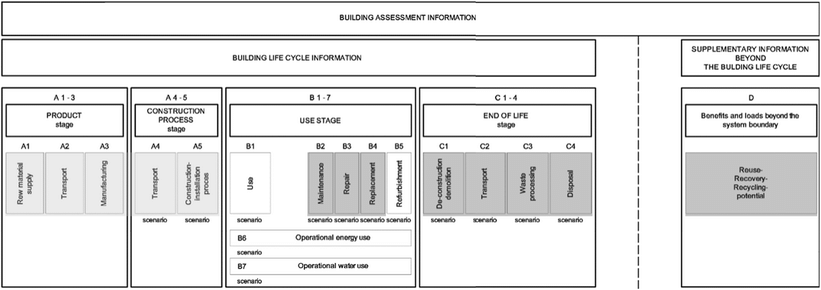
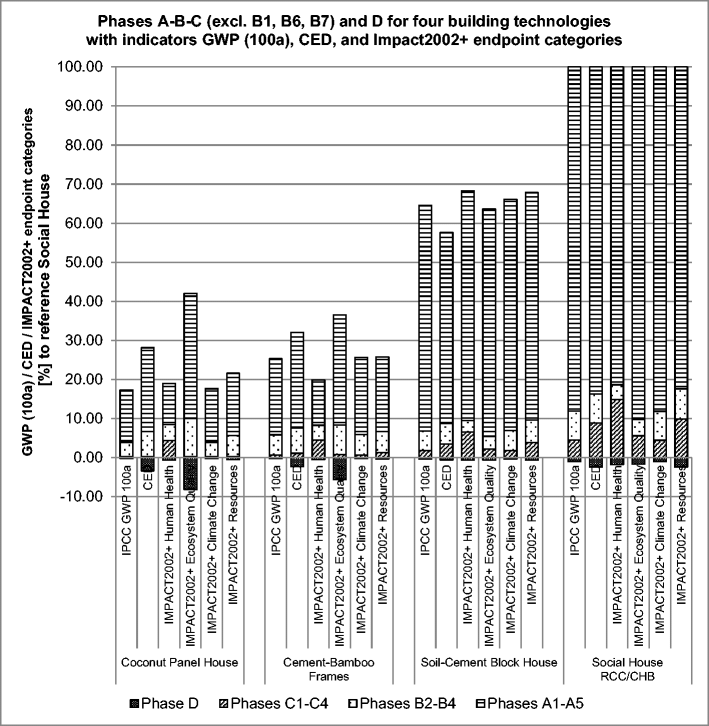
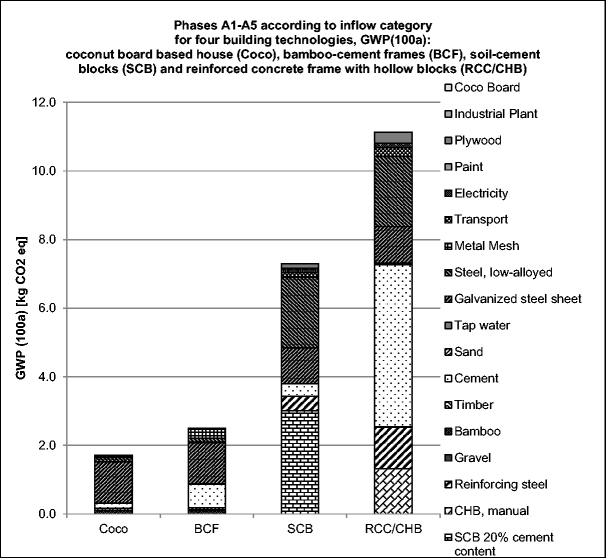
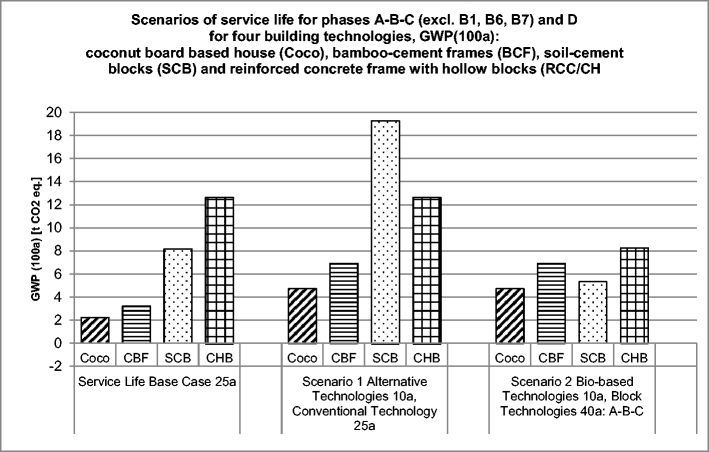
Purpose The environmental impact of the social building stock is relevant, particularly in emerging economies. Life cycle thinking is not yet established, however. Locally available, alternative building concepts could potentially reduce the environmental impact of the construction segment. This paper examines the environmental performance of “as-built” low-cost housing for example in the Philippines, and the potential to reduce its environmental impact through the use of three alternative building technologies: cement–bamboo frames, soil–cement blocks, and coconut board-based housing. Methods Life cycle assessment models are implemented and evaluated with software SimaPro, using the single-impact indicators global warming potential (GWP) and cumulative energy demand (CED) and the multi-impact indicator Impact2002+. According to EN 15978, the life cycle phase product and construction process (A), use stage (B), end-of-life (C), and supplementary information beyond the building life cycle (D) have been assessed. Theoretically calculated inflows from standard construction procedures used in phase A have been verified with 3 years of empirical data from implemented construction projects. For phases B, C, and D, attention was given to service life, use-phase, allocation of waste products, biogenic carbon, and land-use assumptions. Scenarios reflect the actual situation in the emerging economy. Processes, such as heat recovery from thermal utilization, which are not existing nor near to implementation, were excluded. Results and discussion For an assessment of the phases A–B–C–D with GWP, a 35% reduction of environmental impact for soil–cement blocks, 74% for cement–bamboo frames, and 83% for coconut board-based houses are obtained relative to a concrete reference house. In absolute terms, this relates to a reduction of 4.4, 9.3, and 10.3 t CO2 equivalents over a service life of 25 years. CED showed higher impacts for the biogenic construction methods coconut board and cement–bamboo frames of +8.0 and +4.7%, while the soil–cement technology was evaluated −7.1% compared to GWP. Sixteen of 17 midpoint categories of Impact2002+ confirmed an overall reduction potential of the alternative building methods, with the midpoint category land occupation being the exception rating the conventional practice over the alternatives. Conclusions It is concluded that alternative construction technologies have substantial potential to reduce the environmental burden caused by the social housing sector. The service life of the alternative technologies plays a vital role in it. LCA for emerging economies needs to incorporate realistic scenarios applicable to their current state or belonging to the most probable alternatives to ensure valuable results. Recommendations for further research are provided.

Figures

Sustainability of Social Housing in Asia: A Holistic Multi-Perspective Development Process for Bamboo-Based Construction in the Philippines

Authors

Corinna Salzer
Holger Wallbaum, Chalmers University of Technology
Luis Felipe López, Base Bahay Foundation Inc.
Jean Luc Kouyoumji

Abstract

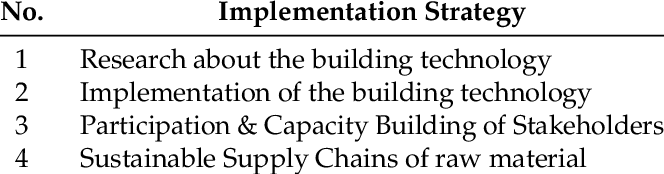
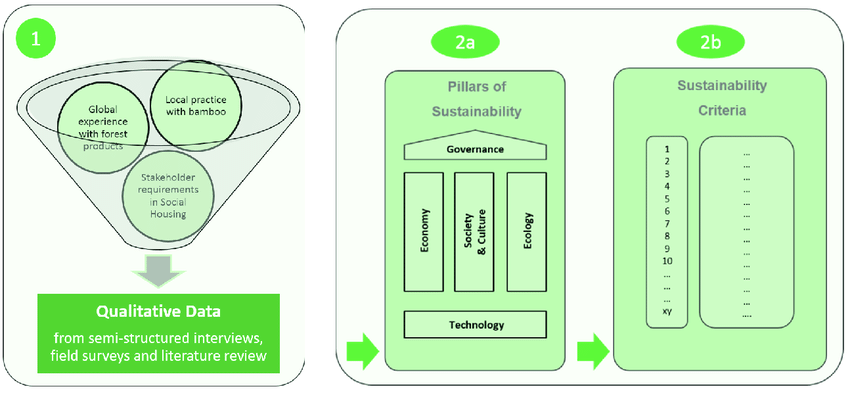
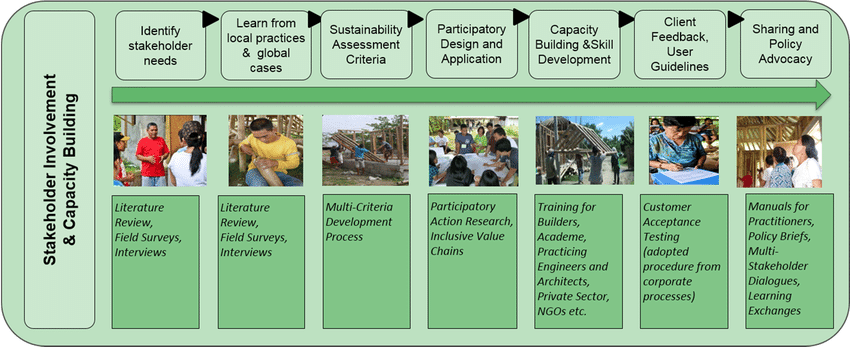
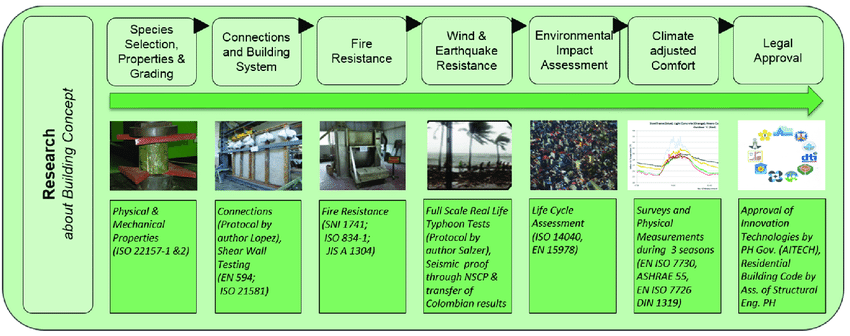
This paper highlights the need for more inclusive and sustainable development of social housing in rapidly developing countries of Asia, Latin America, and Africa. In the example of the Philippines, a multi-perspective development process for a bamboo-based building system is developed. Sustainability Assessment Criteria are defined through literature review, field observations, and interviews with three stakeholder clusters: (1) Builders and users of traditional bamboo houses in the Philippines; (2) Stakeholders involved in using forest products for housing in other countries around the world; and (3) Stakeholders in the field of social housing in the Philippines. Through coding and sorting of data in qualitative content analysis, 15 sustainability assessment criteria are identified clustered into the dimensions of society, ecology, economy, governance, and technology. Guided by the sustainability criteria and four implementation strategies: (A) Research about and (B) Implementation of the building technology; (C) Participation and Capacity Building of Stakeholders; and (D) Sustainable Supply Chains, a strategic roadmap was created naming, in total, 28 action items. Through segmentation of the complex problem into these action items, the paper identifies one-dimensional methods leading to measurable, quantitative endpoints. In this way, qualitative stakeholder data is translated into quantitative methods, forming a pathway for a holistic assessment of the building technologies. A mid-point, multi-criteria, or pareto decision-making method comparing the 28 endpoints of the alternative to currently practiced conventional solutions is suggested as a subject for further research. This framework paper is a contribution to how sustainable building practices can become more inclusive, incorporating the building stock of low-income dwellers. It bridges the gap between the theoretical approach and practical applications of sustainability and underlines the strength of combining multi-dimensional development with stakeholder participation.

Figures

Innovation for Low-Rise Construction in the Urban Tropics: Utilization of Structural Bamboo for Cost-Efficient Housing

Authors

Corinna Elaine Salzer
Clara Camarasa, International Energy Agency (IEA)

Abstract

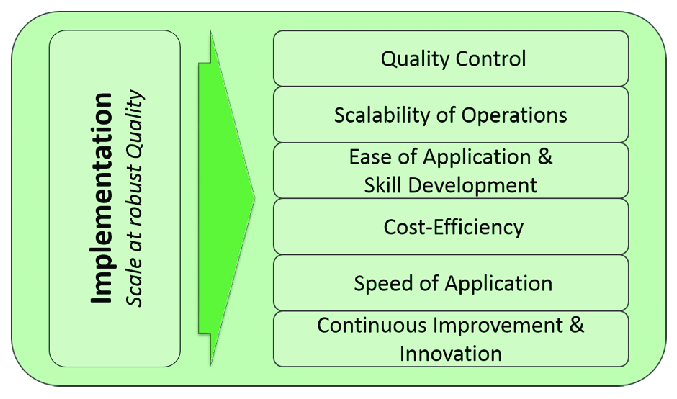
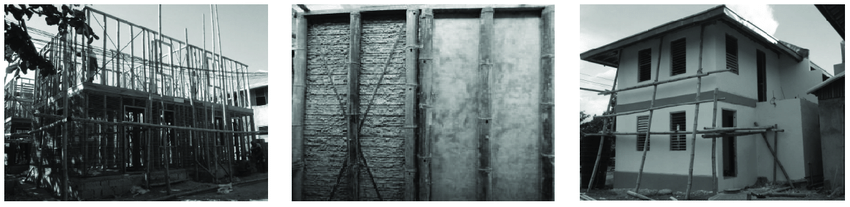
This paper deals with a cost-efficient construction technology using load-bearing bamboo for urban low-rise housing in tropical Asia-Pacific. The potential of the technology to be applied a larger scale is discussed in the example of the Philippines as a pilot country for its application. The assessment of alternative construction methods such as this one is motivated by a tremendous need for more affordable, sustainable, and resilient housing around the globe. The urban poor, being the most underserved group in need of housing, often cannot afford conventional building technologies offered by the formal industry. Using locally available bamboo as a structural component within the introduced standardized and quality-controlled construction method is an entry point to provide performing and safe housing at a lower cost. The paper highlights, however, that cost-efficiency and technical performance are not the only requirements for innovations to succeed in a market, especially due to the complex challenge of urban poor housing. Through learnings from the construction of 50 houses in the Philippines and interviews with various stakeholders along the value chain of the technology, barriers and opportunities for a scale-up are retrieved. For this paper, a conflated non-exhaustive overview of the identified aspects is documented. It was found that both barriers and opportunities directly linked to this technology are closely tied to a complex local value chain which ranges from the upstream supply of raw material to downstream customer acceptance. The pilot application has shown further, that participatory product development reduces the acceptance barrier significantly by directly addressing the needs of low-income customers. Material and skills availability, enabling policies and approval by legal entities as well as sustainability in supply of the organic raw material play important roles too. This complex set of interlinked aspects needs to be addressed according to targets in implementation-pace, and -scale as well as its intended social value creation. While multi-stakeholder participation is required for a successful up-scaling, a facilitating social enterprise, providing knowledge and services around the technology, can guide through the up-scaling.

Environmental Savings Potential from the Use of Bahareque (Mortar Cement Plastered Bamboo) In Switzerland

Authors

Edwin Zea Escamilla, ETH Zurich
Guillaume Habert, ETH Zurich
Luis Felipe López, Base Bahay Foundation Inc.

Abstract

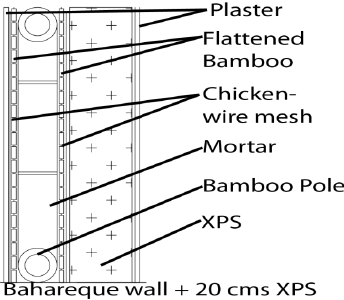
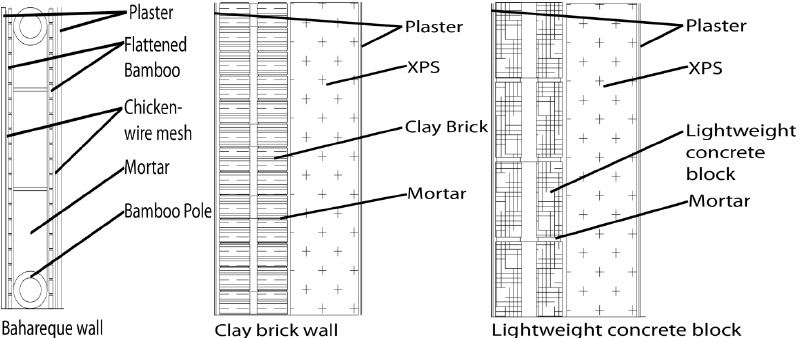
The urgency for energy and material efficiency in the building sector increases every day. In the case of Switzerland, a building’s main energy demand occurs during its use/operation phase and is mainly related to heating demands during the winter season. As a means of reducing these demands, the current building practice in Switzerland is to insulate with 30cm of foam and to mechanically control indoor environments. Recent research has shown, however, that alternatives to current practice are readily available. With these alternative techniques, natural materials with low embodied energy are used to produce high-efficiency building envelopes. The bahareque construction method (bamboo plastered with mortar cement) studied in this paper has been identified as a promising technology both in terms of producing energy-efficient building envelopes and also with regards to reducing the environmental impact associated with the construction of buildings in Switzerland. The main objective of the research presented here was to identify the Environmental Savings Potential (ESP) of bahareque in comparison with state-of-the-art technologies in Switzerland. The calculations were geographically limited to Switzerland and the main data sets used for the life cycle assessment models corresponded to this region. Specific datasets were developed for bamboo and bahareque to account for transoceanic transportation. The results showed that bahareque achieves an ESP of 32% compared with clay brick construction and 40% when compared with concrete block construction. It was shown that it is feasible to develop highly efficient building envelopes with low embodied energy that can be used within the Swiss context.

Figures